
Short answer: before any demolition project in Florida begins, the property must be surveyed for asbestos by a licensed inspector, and if regulated asbestos-containing material is present, a written notice must be filed with the Florida Department of Environmental Protection (FDEP) at least ten working days before demolition starts. Skipping this step is one of the most common and most expensive mistakes on renovation and teardown projects, and it applies regardless of whether the building looks obviously old or not.
Demolition debris is not treated the same as everyday construction waste under Florida law, and for good reason. According to the U.S. Environmental Protection Agency, demolition activity accounts for more than 90 percent of all construction and demolition debris generated nationally, while new construction makes up less than 10 percent. That single fact explains why demolition specifically draws heavier regulatory attention than a typical remodel.
Step One: The Asbestos Survey Is Not Optional
Under Florida Statute 469.003, no one may conduct an asbestos survey, prepare abatement specifications, or perform asbestos abatement work without being licensed by the state as an asbestos consultant or contractor. This licensing requirement exists alongside the federal Asbestos National Emissions Standard for Hazardous Air Pollutants (NESHAP), found at 40 CFR Part 61, Subpart M, which governs how asbestos-containing material must be identified and handled before a structure comes down.
In practical terms, this means a general contractor cannot simply assume a building is clear of asbestos because it looks modern or was renovated recently. A licensed asbestos consultant needs to inspect the property and document the findings before a demolition permit should move forward, and before any dumpster or debris removal plan is finalized.
Step Two: The Ten-Day Notice to FDEP
If the survey finds regulated asbestos-containing material above NESHAP thresholds, Florida requires a Notice of Renovation or Demolition to be submitted to FDEP at least ten working days before the project starts. This notice requirement is separate from the local building permit and is easy for a project team to overlook if the asbestos survey and demolition permit are being handled by different parties. Missing this window can delay a demolition start date by weeks, not days.
How Florida’s C&D Debris Rules Apply After the Building Comes Down
Once demolition is underway, the debris itself is regulated separately. Florida Administrative Code Rule 62-701.730 governs how construction and demolition debris must be handled, requiring permitted disposal or recycling facilities and, on larger projects, waste inspection and reporting protocols. C&D debris makes up roughly a quarter of Florida’s total solid waste stream, which is part of why the state tracks its disposal more closely than ordinary household trash.
- A licensed asbestos survey is required before demolition, not just before renovation
- Regulated asbestos-containing material requires a written notice to FDEP at least 10 working days before demolition begins
- Demolition debris must go to permitted disposal or recycling facilities under Florida DEP Rule 62-701.730
- Local building departments require proof of utility disconnection alongside the demolition permit application
- Documentation should be kept on site throughout the project, not filed away after the permit is issued
Material Separation and Recycling Expectations
Florida’s C&D debris rules also factor into how demolition materials are sorted once they leave the site. Rule 62-701.730 supports permitted recycling and processing facilities alongside disposal, and larger demolition projects are increasingly expected to route recoverable materials such as concrete, metal, and clean wood to recycling rather than straight to landfill. Coordinating this with your hauler in advance, rather than assuming all demolition debris goes to the same place, can also reduce disposal costs, since recycled materials are often processed at a lower rate than mixed landfill debris. Contractors working across county lines can review How to Handle Construction Debris Legally in Boca Raton for how these same sorting and disposal expectations apply on the Boca Raton side of a project.
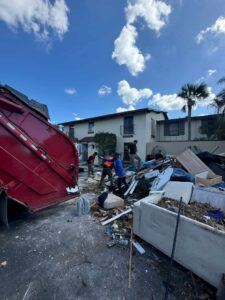
What This Looks Like on an Actual Job Site
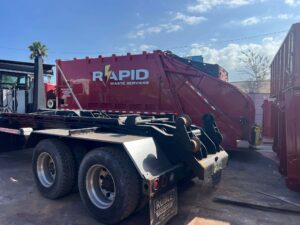
On interior and selective demolition projects across Delray Beach and Boca Raton, Rapid Waste Services coordinates Demolition Services in Delray Beach, FL and Dumpster Rentals in Boca Raton, FL around the compliance steps a contractor has already completed, rather than treating debris removal as a separate, disconnected task.That means confirming a project’s demolition permit and asbestos documentation are in place before scheduling roll off dumpsters, so debris removal moves at the same pace as the rest of the project instead of becoming the step that holds everything up.
Timeline Considerations Contractors Should Build In
Most Florida counties issue demolition permits within five to fifteen business days once documentation is complete, but that clock does not start until the asbestos survey and any required abatement work are finished. Contractors who build the asbestos survey and the ten-day FDEP notice into their earliest project planning, rather than treating them as a step to handle once the permit application is already in review, consistently avoid the scheduling gaps that stall demolition starts.
The Cost of Getting This Wrong
Asbestos compliance failures are not a minor paperwork issue. Under Florida law, each party found responsible for non-compliance, whether that is the property owner, the general contractor, or a subcontractor, can face penalties as high as $10,000 per day per violation. Beyond the direct financial exposure, a project found out of compliance can be stopped mid-demolition until the asbestos survey, notification, and any required removal work are completed, which is a far more expensive delay than simply building the survey into the project timeline from the start.
It is also worth noting that completing a local building permit application does not, on its own, satisfy the federal NESHAP notification requirement. These are two separate processes handled by two different agencies, and contractors sometimes assume that pulling a city or county demolition permit automatically covers the federal notice. It does not, and treating them as one step instead of two is a common source of costly delays.
Who Should Be Involved Before Debris Removal Starts
Because responsibility for asbestos compliance can fall on multiple parties depending on the project structure, it helps to name who is handling each piece before demolition day arrives. A licensed asbestos consultant handles the survey. The property owner or general contractor typically files the FDEP notification if required. The demolition contractor and debris hauler need copies of the completed survey and notification on file, since a hauler removing debris from a site without documented clearance is taking on risk it should not have to carry. Coordinating this handoff early, rather than assuming it will sort itself out once the dumpster arrives, keeps the entire project moving on schedule.
Frequently Asked Questions
Q: Do I need an asbestos survey before demolishing a building in Florida?
A: Yes. Florida requires a written asbestos survey by a licensed inspector before demolition of any structure, regardless of the building’s age or apparent condition. This is a state and federal requirement, not a local option.
Q: How much notice does FDEP require before demolition?
A: If regulated asbestos-containing material is found, a Notice of Renovation or Demolition must be submitted to FDEP at least 10 working days before the demolition start date.
Q: Does demolition debris have different disposal rules than regular construction waste?
A: Yes. Florida Administrative Code Rule 62-701.730 governs construction and demolition debris disposal and requires permitted facilities, along with waste inspection and reporting protocols on larger projects.
Q: Who is responsible for asbestos compliance on a demolition project?
A: Responsibility can fall on the property owner, property manager, general contractor, or subcontractor, depending on the project. Each party should confirm the asbestos survey has actually been completed rather than assuming another party has handled it.
Q: How long does demolition permitting take in Florida?
A: Most counties issue demolition permits within 5 to 15 business days once documentation is complete, but the asbestos survey and any required abatement must be finished first, which is the step most likely to affect the overall timeline.
| Planning a demolition project in Boca Raton, Delray Beach, or Palm Beach Island? Rapid Waste Services coordinates roll off dumpster delivery around your project’s compliance timeline. Schedule your demolition debris removal today. |
Sources
U.S. EPA, Sustainable Management of Construction and Demolition Materials (demolition generates 90%+ of C&D debris): https://www.epa.gov/smm/sustainable-management-construction-and-demolition-materials
Florida Department of Environmental Protection, Asbestos Program: https://floridadep.gov/air/permitting-compliance/content/asbestos
Florida Department of Environmental Protection, Asbestos FAQ: https://floridadep.gov/air/permitting-compliance/content/asbestos-faq
Florida Statute 469.003, License Required (asbestos consultants and contractors): https://www.flsenate.gov/Laws/Statutes/2024/0469.003
About the Author
Rapid Waste Services provides interior demolition, selective demolition, and construction debris removal for commercial and residential projects across Boca Raton, Delray Beach, and Palm Beach Island. As a City of Boca Raton Authorized Commercial and Construction Debris Hauler, the company works alongside contractors and demolition crews to keep debris removal on schedule and within local requirements.